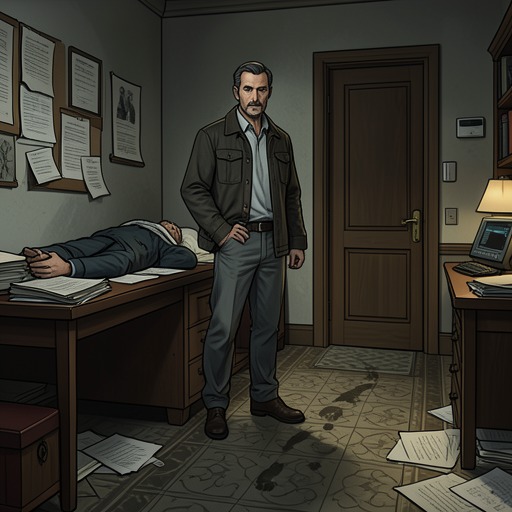
Facts and Inferences
The Pale Blue EyeFacts and Inferences names both the method Augustus Landor claims to follow and the tension that governs his account. He prefers tangible evidence to metaphysics, treating facts and the inferences drawn from them as the spine of a life and a case. Yet the distinction is unstable: a clue can support a theory without proving it, and the person arranging the clues may not be trustworthy.
Facts as Foundations
Landor makes the need for foundations vivid through the memory of a child building a sand cathedral. She planned its abbeys and bell towers but not for the tide; as the water advanced, the structure became humps in the sand. For Landor, the image warns against building an elaborate explanation on uncertain ground. A theory may be beautiful or persuasive, but what survives scrutiny is the foundation beneath it: the simple facts.
That principle guides his reconsideration of Leroy Fry’s death. The initial account could be made to support suicide: a young man had hanged himself, perhaps because he had been beaten down by life. Landor tests that explanation against what such a conclusion would lead one to expect, including a note explaining the decision. No note is found. The absence does not by itself prove murder, but it weakens the ready-made story of a willing death and makes the missing evidence part of the investigation.
The physical examination adds further, distinct traces. Leroy Fry’s hands have blisters, his neck bears rope burns, and a contusion is found on the back of his head. Dr. Daniel Marquis identifies the injury as a contusion; when asked what could have caused it, he explains that a hard object striking the head could produce such a lump. He also reasons that a bruise is unlikely to have been inflicted after death, since it depends on blood escaping from circulating vessels. The examination thus supplies a possible sequence—head injury before death—but does not identify who struck Leroy Fry or establish the full circumstances on its own.
Taken together, the absent note, the signs on the hands and neck, the position of the feet, and the head injury make suicide less convincing to Landor. He proposes that someone struck Leroy Fry, put the noose around his neck, and tightened it. But he marks this as a theory rather than a demonstrated fact. The distinction matters: evidence can redirect an inquiry and make one explanation more plausible without converting inference into certainty.
Precision, Testimony, and the Limits of Inference
The method also depends on how evidence reaches the investigator. Epaphras Huntoon found Leroy Fry only because he happened to pass close enough to notice him: the night was cloudy, the moon no more than a thumbnail, and Huntoon’s lantern offered the only light. Landor later imagines that a yard’s difference in either direction might have left the body undiscovered. The discovery is therefore a fact, but its occurrence turns on chance; what becomes available for investigation is not the whole past, but the portion chance makes visible.
Landor’s insistence on precision shapes his recruitment of Edgar Allan Poe as an inside observer. At first, Poe is to watch for what might matter, though Landor admits they do not yet know whether the culprit is a cadet. He also gives Poe a fragment of a larger note to decipher, asking him to work secretly and carefully. The fragment is not self-explanatory: it must be read in relation to the missing whole, and its interpretation can be no more secure than the attention given to its wording. Landor’s brief maxim, “Precision is all,” sets a demanding standard, but it also exposes the method’s dependence on human acts of observation, transcription, and interpretation.
The same evidentiary discipline applies to testimony. In questioning Private Cochrane about the night Leroy Fry’s body disappeared from the hospital, Landor sets Cochrane’s current account beside an earlier statement. Cochrane now says he was relieved of duty at about half past two; Landor recalls that the first statement named Lieutenant Kinsley as the person who relieved him. The discrepancy gives Landor a specific point to examine, rather than a general impression of evasiveness. It does not, by itself, settle what happened: a changed detail is a clue requiring comparison and judgment, not a conclusion that can safely stand alone.
The method’s sharpest complication arrives when Poe lays two scraps side by side. One is the note found in Leroy Fry’s hand; the other is a note Landor had left for Poe. Landor acknowledges that he wrote the latter to ease his conscience, though the effort could not succeed. The paired papers change the meaning of the investigator’s earlier work: the man who collected and interpreted evidence has also placed a document into the chain of evidence himself. The episode does not erase the physical traces or the testimony, but it makes their arrangement—and the authority of the person arranging them—part of the problem. Facts remain indispensable; they do not guarantee that the inferences built from them are innocent.
Retrospective Method and the Returning Past
The distinction between fact and inference also shapes how Augustus Landor tells his story. He recalls arguing with an absent interlocutor about whether he possessed a soul: Landor demanded empirical confirmation, while the other man insisted that the soul would become unmistakable at the instant it left him. The disagreement sets material proof against metaphysical conviction, but Landor does not present the contrast as a simple victory for reason. His own account begins with memory and imagination, even as he declares facts and inferences its spine.
A dream after a year of retirement makes that tension concrete. Landor’s daughter finds him talking in his sleep, questioning a suspect who had been dead for twenty years. In the dream, the man had cut up his wife’s body and fed the pieces to watchdogs in a Battery warehouse; Landor remembers the suspect’s shame and apology, and his own response that someone else would have occupied the suspect’s place. The scene is not new evidence about the old crime so much as evidence about Landor: even asleep, he continues to question, test, and explain.
The dream leads Landor to recognize that a career cannot simply be left behind. Withdrawal into the Hudson Highlands, books, ciphers, or walking sticks cannot prevent the work from returning to him. In this framing, “facts and inferences” names not only an investigative procedure but also a limit on escape: the past persists as material to be examined, while the conclusions drawn from it remain exposed to revision.
The Reader’s Share in Inference
The method implicates the reader as well as the investigator. The two scraps are not introduced together at the outset: their placement side by side near the end turns reading itself into a fresh comparison, asking the reader to reconsider what each document means in light of the other. The delayed juxtaposition makes the form enact the problem it names. A piece of evidence can seem settled when isolated, then change force when another piece supplies a context—or when the investigator’s own hand is found among the traces. Facts and inferences therefore describes not a finished ledger of certainty but a process of rereading, in which new relations among the evidence can alter the account already built.